Stoke in the guardian
Project by Andy Parker
Replace project

Tuesday, 2 April 2013

Monday, 1 April 2013
Andrew Brown

- Post-industrial landscapes
- Exploring moments in time, being ‘present’
- Thresholds and spaces betwixt and between
and
approaches:
- Retracing steps
- Design direct embodied experience
- Solitary vs. collective
- Making use of what is there
- The particular effectiveness of sound
 and found
myself initially drawn to signage, personal effects and inscriptions that gave
insights into the the former Spode workforce. As I explored tentative routes
began to form for a group walk, taking participants from one sonic environment
to another.


For
’Topographies of the Obsolete’ March 2013 I
returned with recording equipment and the intention of effecting a
temporary repair of the works bell. This I recorded from various parts of the
site.
 I’d been put
in contact with local archivist Ray Johnson (from the Staffordshire Film
Archive) with whom I spent a couple of highly productive hours, as well as one of the key members of Airspace gallery, Anna Francis. Meeting her, Glen and Andy provided a cultural dimension that
was previously missing for me.
The bus tour
of Bradwell woods, Etruria, Gladstone and Burslem was also significant, making
the place more comprehensible as a city. To develop this, and to begin to
address the second strand of my project I performed several walks, to Cobridge,
along the canal towpath to Westport Lake, back to Spode via Burslem and Hanley
Park, to the Garden Festival site, and finally to Harecastle tunnel.
Overall I am
pleased to have overcome my initial rush of naieve excitement regarding the
site and, through having now worked there a second time and for a longer
period, I feel I am better-placed to produce a mature response.
Friday, 29 March 2013
Laura Twigg


Working
with my enjoyment of materials my work draws from the interaction between the
readymade and the handmade. Collecting found
materials within the space is a communication of the relationship between
material and form. By contrasting these I am exploring the context of objects
in relation to the histories of the material. I am inspired by the materiality
of objects, their nature of form and how we adapt these into our environments.
I am interested in the tension between natural and fabricated form and
sculpturally how this creates a sense of spatial awareness. Informed by a sense
of labour and craft, ceramic form communicates a concern of craft and mass
production. Raw clay communicates malleability, allowing me to directly react
with the material in a space in an instinctive way. Completing a residency at
Spode in my hometown of Stoke-on-Trent has identified an exchange of cultural
materiality between students from The University of Nottingham Trent, Muthesius
Kunsthochschule, Bergen Academy of Art & Design, The Royal Academy of Art
Copenhagen, Newcastle-upon-Tyne University and Sheffield Hallam University.
Identifying these new relationships has broadened my conceptual understanding
of ceramics and sculpture. Working with ceramicists and technicians has allowed
me to access ideas and combine a social awareness with writings such as
‘Failure’ by Lisa Le Feuvre and ‘The Dematerialisation of the art object’ by
Lucy Lippard.
Thursday, 28 March 2013
In Memory of Holocene
Reactive dyes in Stoke on Trent
March 2013
Margrethe Kolstad Brekke
http://www.youtube.com/watch?v=m4pr8EmqGtg
Reactive dyes in Stoke on Trent
March 2013
Margrethe Kolstad Brekke
http://www.youtube.com/watch?v=m4pr8EmqGtg
entering anthropocene scetchwork
sitespecific workshop initiated by Lisa Stenbro
Yas Island UAE, February 2013
Margrethe Kolstad Brekke
http://www.youtube.com/watch?v=BZbb75X90Zw&feature=share
sitespecific workshop initiated by Lisa Stenbro
Yas Island UAE, February 2013
Margrethe Kolstad Brekke
http://www.youtube.com/watch?v=BZbb75X90Zw&feature=share
In Memory of Pleistocene
Reactive dyes in Stoke on Trent, September 2012
Margrethe Kolstad Brekke
http://www.youtube.com/watch?v=q1pBgBFfo_w&feature=share
Reactive dyes in Stoke on Trent, September 2012
Margrethe Kolstad Brekke
http://www.youtube.com/watch?v=q1pBgBFfo_w&feature=share
Sunday, 10 March 2013
Site specific work in progress in an abandoned paint factory
We decided upon an abandoned place in an ruinous state where we could work uninterrupted, to try out methods, concepts and materials in a direct response to a site. It was intense work for two weeks, in the cold and limited daylight of february. We made an opportunity for others to come over to see our works in progress and have a discussion about out them.
It was a chance to get into working mode before the second part of the Stoke Project.
Karin
I wanted to
use the time in this space to develop strategies of site specific works. It is
a very different experience to work out side with much harder physical
conditions than inside in the studio. If you just can keep
warm for two hours and if the clay freezes over after half an hour that of cause
affects the work and you have to find ways to work around it. I used materials on site to be part of my interventions which also pushed
and shaped the work in more than just the obvious, physical way.


Erna
Ruins are an ongoing process, nothing is today as it was yesterday, and it won´t be the same tomorrow. It is a natural process where nature or man keep layering on top of each other, dust, leaves, trash, spray paint etc. I attempted to highlight that gradual transition by either adding to or taking away from a structure, to build up or clean away the layers, to dramatize the dreamlike nature of the change.
There were three attempts:
In an Paint Factory, using paint as a material has many implications, in the life of this building the focus has shifted from being a producer of paint to being a recipient of it in the form of spray paint. It is a natural growth, gradual growth, as is the accumulation of leaves, plants and trash.


In a ruinous place there are many layers to be found, dust and broken glass cover the floors. The glass shards were cleaned and now shine when the light hits the dusty floor.

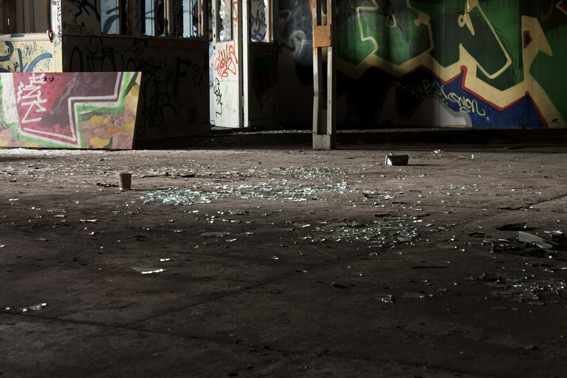


Porcelain was laid out on the floor, it picked up, natural pigments, left from another artist, it froze in the frost and a new form of porcelain roses was formed. A porcelain, frostrose desert.


Subscribe to:
Posts (Atom)