Topographies of the Obsolete is an artistic research project that focuses on the closed Spode Works in Stoke-on-Trent, UK.

The first workshop Resurrecting the Obsolete took place in September 2012 in the Spode Factory, Stoke on Trent, UK organized by Bergen Academy of Art and Design, Norway (KHiB).

KHiB was invited as a Research Fellow Partner Institution by the British Ceramics Biennial 2013 and the first workshop included 33 staff and students from KHiB, The Royal Academy of Art Copenhagen, Muthesius Kunsthochschule Kiel, Sheffield Hallam Univerisity, University of Nottingham Trent and invited alumni/artists from KHiB. Together we explored the Spode site’s histories, industrial space and infrastructure.

The workshops have uncovered a variety of methods and strategies exploring the complexity of the site from different perspectives and practices particular to each of the artists/students involved. We had a great variation of expressions ranging from the performative intervention based to installation and object based work.

The second of the research residency took place in March 2013 as the artistic research project Topographies of the Obsolete. The third workshop takes place in August 2013.

In September a number of participants from the research project will present their works during the British Ceramics Biennial 2013.

This site will act as a meeting point for participants and others interested in our progress.

Thursday, 14 February 2013

Richard Launder ROUTEMASTER: Spode Office


Resurrecting the Obsolete
Research Residency 1.

RICHARD LAUNDER

                                                              Age of Enlightenment


Starting Strategies (Sept. 8 - 18th 2012): enacted upon simultaneously (especially days 1 and 2):
·      assemble all movables which mutely appeal, make note of others not so easy to move (photo document, write in register)
·      Physically walk thro the buildings and roads, try to get lost and assemble a mind-map of these (photo document, write in register)
·      Oblique strategy: enter every unlocked door (we were told that we could enter all doors that were open: in relation to security risk), enter and move onward until stopped, retrace steps, start again.
These Situationist approach’s gave a speedy accumulation of site knowledge - the physical buildings, spaces, levels, inside/outside and importantly, via the collecting, moving, testing and the observation involved: an overview about the former employees together with their particular professional areas, jobs, skills and even some individual personal aspects (of which, more later) Enabling a psycho-geographic reading.

Procedural Strategies: while simultaneously continuing the above, though to a lesser degree:
·      Locate a variety of spaces/objects which ‘push back’ and speak: the emotive atmosphere of pressure/deadlines, movement, physical work/wear & tear, tools, plans/maps, reports, unfinished ceramics
·      Particular atmospheres I was stimulated to find: focused concentration, traces of time passing, dereliction, threads of connections (internal and external)
·      Hold in mind certain issues: ‘Paths of Desire’, ruins, walking, archives, psycho-geographies, create rules, Destruction Art,
·      Start to work with these empirically/intuitively articulating the spaces, the movable materials, background narratives/knowledge gained
·      Be open to: performative/video, sculptural, installation, /sculpture, photographic, text possibilities and combinations
By journeying through these I came to proceed with a group of potential projects which developed in parallel, and often in conversation with each other; they all moved along at different speeds some clearly needing a lot more time/concentration, others arriving fairly effortlessly - nice when that happens.

Research Residency 2: 9 - 19 March 2013

ROUTEMASTER: Spode Office

ROUTEMASTER´S Desktop, Walks & Maps

Umbrella title for a group of interrelated works conceptualised, produced & curated from the ROUTEMASTER: Spode Office, a physical space, extant Sept. 2013 - Dec. 2013? (Distribution to be negotiated)

·      A contextualised ‘viewing space’ - an office which it is possible to view into from 4 sides (goldfish bowl like) it becomes a performative installation, with a potential for guided (limited numbers) audience to enter and potentially interact (in direct opposition to both the history of the site) From this HQ, other works are conducted - the balance between fictive and real office is resolved by the 2 desks inherited in the room.                                            The room was staged (originally in Sept. 2012) to convey an atmosphere of competence, confrontation, on the brink of dis-function/chaos; a maximallist approach to intense detail, placing layers of suggested narrative, potential past/future/present actions/events and the files, plans, maps, tools/equipment (individually doctored), samples, reports, personal items...which are their alibis.  After a year of occupancy, a new layer of dust, light markings/fadings, together with evidence of recent activities will become part of the accretion.                                      ROUTEMASTER: Spode Office:  title, came about by being asked directly by Julia Collura (collaborative partner for a performance work): who’s room is this? What is this person doing? What is the character of the person whose office this is?                                                             Staging /performance texts/sketches, Julia & I will have time on-site in March to run thro some of our collaborative concepts (sound: the old AEOLIAN grand piano/costume/progression of site - the potential of a ‘processing audience’)                                                                                                                              Location: office, originally the heart of the factory: technical personnel, those who found solutions/kept production rolling; 1st floor of 1950´s Designers block.   

 ROUTEMASTER: Spode Office: a selection of curated on-going works:

·      White on White: performative place/performing objects: partially finished ceramic plates performing.  Needs:  editing, staging texts developing sound recordings, more filming on site, further investigating access to the top round window (via a trapdoor)                                                                                                     Location: main arterial road connecting the old front of factory (admin. /sales/museum) to the various production areas, Designers block, 1950´s functionalist building; all brickwork painted matt white, plates are matt white.


                                             White on White: performance video still

·      Topography of  Routemaster´s desktop and Walks:  A found partial plan of the site with a circle marked out, no information about why. Use to investigate the circle as a derive, attempt to walk it through the labyrinth site (rule: follow the circle as closely as possible, only enter through open doors) Map this out using various tools/materials on a large scale full plan of the factory (found), placed on the Routemaster´s desk- leave as evidence of activity (frozen in time). Needs: Allocate time for further walking and collecting approaches: investigate sound recording/ register opportunities.


                                                                  Paths of Desire

·      bone to bones: a performing story of material and manufacture involving ruin/climate-erosion/decay: nature; contra protection/ shelter/refinement: civilisation; in relation and as comment to the contemporary economic and political position of materialist/consumer culture. A noble savage for our times? From a quasi archeologic/geologic/construction site position.                                                     Proposed scale: two square floor areas covered by an echo of galvanised corrugated roofing. (Approx. 2 m x 2m)  with guttering exchanging the rain & leak waters.  Installation to be constructed in March, then needs to be left in-situ to weather until the biennial. Documentation during erosion process, footage may become a video. Location: leaking roof is located and a pipeline route to the nearby outside courtyard area.                                                                                              


Monday, 11 February 2013

Trying to make the best of it.

To me the Spode factory is like an old friend or relative, not just a random factory, it's special. It has led a long and full life and if it had not been for us, the humans who have developed a certain relationship to it, it wouldn't mind to just die in peace. It is we who want it to get better, we hold on and try to clean up what we can while the factory is getting dirtier and weaker by the day. We want it to give us more, to tell us more stories about when it was young, about all the people it has known, but the factory is just a factory. 

It's clear no one will ever be able to save it, maybe give some parts of it a facelift, but it won't be the same. 


Works from the factory september 2012:


Ceramic tiles/cut-up decals from site.


Works from Rom8 in Bergen, October 2012:


Bone china from site/Limoges porcelain/self-made decals


Anne Stinessen

Research in Progress exhibition/presentation Rom8, Bergen, Norway


Reading List


Here is the list of publications we have all contributed with, thanks for all your suggestions. Keep them coming.


·       “The return of the real: Art and Theory at the end of the Century: Anant-gard at the end of the century”. Hal Foster.
·       “One Place after another: site specific art and locational identity”. Miwon Kwon.
·       “The Craftsman.” Richard Sennet.
·       “The corrosion of Character: personal consequences of work in the new capitalism.” Richard Sennett.
·       “Staging the people: the proletarian and his double.” Jacques Ranciere.
·       “The Poetics of Space.” Gaston Bachelard.
·       “Space and Place.” Yi-Fu Tuan.
·       “Storming the Gates of Paradise.” RS Solnit
·       “Edgelands”. Michael Symmons Roberts, Paul Farley.
·       “Restless Cities.” Matthew Beaumont.
·       “The possibility of life’s Survival on the planet.” Patrick Keiller.
·       “Place (Art Works)”. Tacita Dean.
·       “Still Moving: Between Cinema and Photography.” Karen Beckman, Jean Ma.
·       “The place of Artists’ cinema space, site and screen.” Maeve Connolly.
·       “The Anthropology of turquoise: reflections on desert, sea, stone, sky.” Meloy Ellen.
·       “History of the Staffordshire potteries: and the rise and progress of the manufacture of pottery and porcelain (1900).” Simeon Shaw
·       “Clayhanger” Arnold Bennett
·       Anna of the five towns.” Arnold Bennett
·       Memories of the Staffordshire potteries”. Mervyn Edwards
·        “The lost city of Stoke-on-Trent” Emma Bridgewater, Matthew Rice.
·       “A plated article. With an introductory account of the historical Spode-Copeland china works to which it refers.” Charles Dickens
·       “Spode-Copeland-Spode: its works and its people 1770-1970.” Vega Wilkinson
·       “Spode and Copeland: over two hundred years of fine china and porcelain. Steven Smith.
·       “Ruins”. Michel Makarius
·       “Drosscape: wasting land in urban America.” Alan Berger
·       “Exploring the site specific: issues of space and internationalism.” Judith Rugg
·       “Artificial Hells: participatory art and the politics of spectatorship.” Claire Bishop
·       “Site specific art: performance, place and documentation.” Nick Kaye
·       “Utopias.” Documents of contemporary art. Richard Nobel.
·       “Species of spaces and other pieces.” Georges Perec
·       “Evocative objects: things we think with.” Sherry Turkle
·        “Archive.” Documents of contemporary art, Charles Merewether
·       “Living as form: socially engaged art from 1991-2011.” N Thompson
·       “Nature.” Documents of contemporary art. Jeffrey Kastner.
·       “Approbation.” Documents of contemporary art. David Evans.
·       “Ruins”. Documents of contemporary art. Brian Dillon.
·       “Situation.” Documents of contemporary art. Claire Doherty.
·        “The Everyday.” Documents of contemporary art. Stephen Johnstone.
·       “Wanderlust: a History of walking.” Rebecca Solnit.
·       “News from nowhere: or, an epoch of rest. Being some chapters from a utopian romance.” William Morris
·       “A modern Utopia.” H G Wells
·       “Ecotopia” Ernest Callenbach
·        “Dead cities: and other tales.” Mike Davis
·       “The aesthetics of natural environments” Allen Carlson and Arnold Berleant
·       “The wild places.” Robert Macfarlane
·       “Art, ethics and environment: a free inquiry into the vulgarly received notion of nature.” Æsa Sigurjonsdottir, Olafur Pall Jonsson.
·       “The aesthetics of the natural environment.” Emily Brady
·       “Worlds Away: New Suburban Landscapes”. Andrew Blauveit; Walker Art Center, 2008
·       “Night Haunts; A journey through the London night.” Sukhdev Sandu; Verso, 2010  (see also associated website:   http://www.nighthaunts.org.uk)
·       “Bipolar Horizon.” Siri Hermansen
·       "Samtidsruinar". Marit Eikemo.
·       Persistent Memories: Pyramiden - A Soviet “Mining Town in the High Arctic”. Hein B. Bjerck, Bjørnar Olsen, Elin Andreassen.
·       "Den emansiperte tilskuer”. Jacques Rancière.
·       “The anthropology of Turquoise”. Ellen Leroy.
·       “New york trilogy”. Paul Auster.
·       “Communities of Sense -rethinking aesthetics and politics”
·       “The world of Downton Abbey.” Jessica Fellowes.

Sunday, 10 February 2013

From last time till next time

My response to the site has been with a project where I attempt to highlight the tear and wear of the buildings, to link together the time period from before and after the factory closed down. Revealing the marks of time that are embedded in the architecture, the skeleton, by adding to the structure and/or taking away from it. By altering, manipulating or alienating parts of a space the whole becomes visible in a different way. 
The free growth of plants and the marks of ruination brings on a feeling of a landscape in the making, which happens when architecture, a piece of construction, is abandoned for a time. The feeling the visual elements from Spode bring to my imagination is similar to the one I get from a desert, a feeling of something being wast, quiet and empty. A desert, like the Spode Factory, has the ability to look and feel empty, although that is not the reality. A desert is a space conceived as dry, hot, vast, quiet and barren. A far away place, distant in both geographical and cultural terms.

A desert can also refer to something that is deserted, left.

Last time I worked on a project I called Timelines:

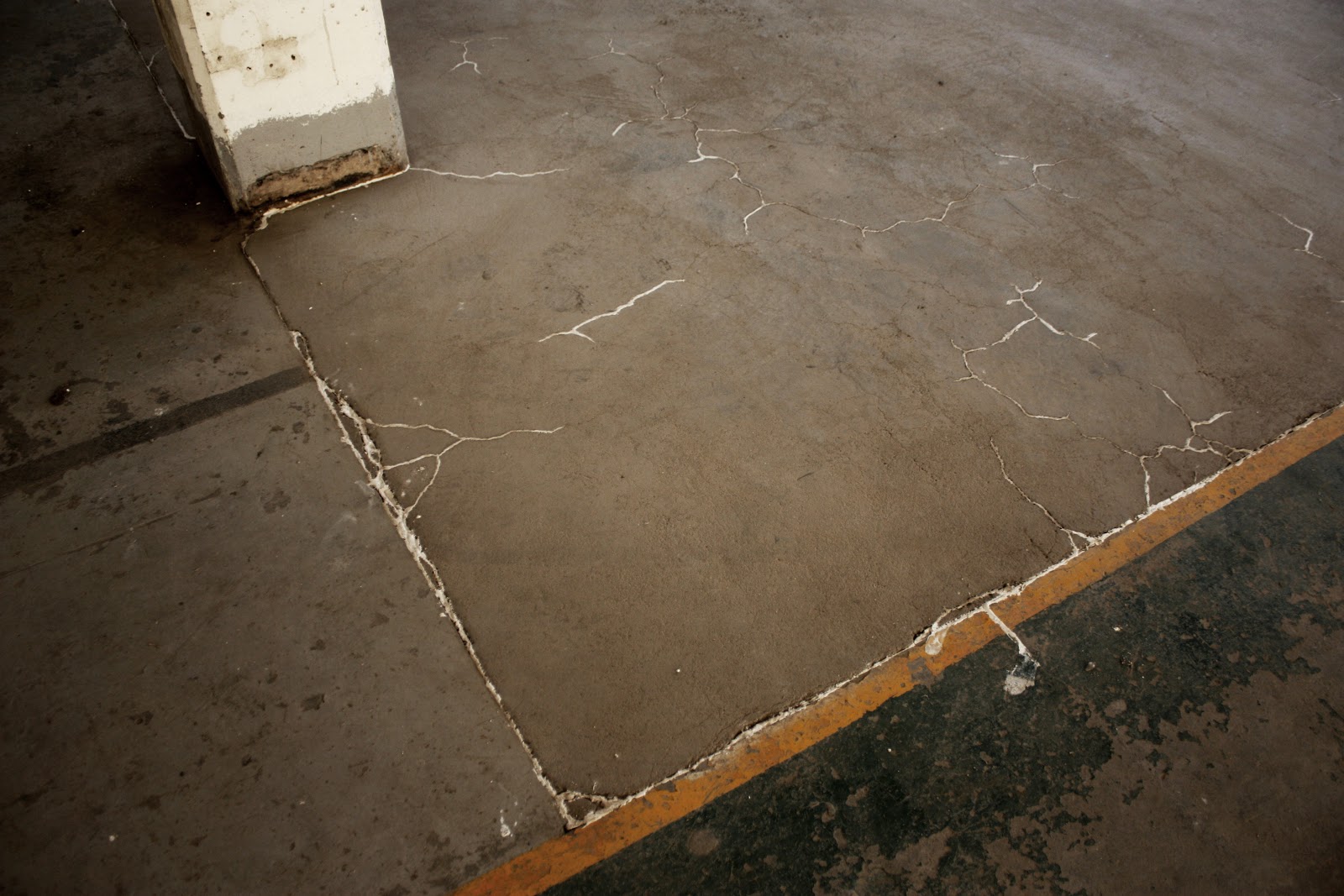
There is a crack in the floor of the China Hall. The crack starts where a walk-path that was painted on the floor ends and it leads out to the wall where on the other side the plants continue growing. The crack connects the path and the growth outside. A timeline of some sort. I filled that crack with Bone China slip from the factory and then another crack and another until I had filled- or drawn up lines that spread over a massive space. The Bone China then cracked inside the veins as it dried out. The highlighting made the subtle landscape of the concrete floor visible.

Crackling bone china inspires me and will continue to be my material.


Tuesday, 5 February 2013

Preparations

Here in Bergen we students are working with the preparations for the coming workshop in march. A week ago we had group tutorial with the projects new research assistant Corrina Tornton were everyone presented there work, were they are now and what they are aiming for during the time on site.
This Friday we also continued our Site Anatomy seminar and got an introduction to Miwon Kwon's From one place to another by Christine Hansen and Kwon's categorization of site specific art.

It makes a lot of sense to meet and discuss in these groups. Our discussions get very focused due to our shared experiences of the issues of working in this special place. I think it pushes us forward and enable us to get to an other level of understanding. Hopefully this will result in even better outcomes of this coming workshop.


Sunday, 3 February 2013

Work Study


The work started out from the idea of efficiancy in action and movement related to production. Archives of schemes for following up, exercising and renewing working processes were found spread over the floor of an office space. The work study system was turned hollow and absurd with the ending of production.

The project aimes at examining and acting out this absurdity as an act of possible reconciliation of the human condition in the process of change.
Following the thinking of Maurice Merleau-Ponty about the body’s relationship to space - traces of which are to be found as well in Yi-Fu Tuan’s writing from a geographical perspective - the first step of research was the sheer movement, by walking, through the factory site, and thereby drawing lines on a GPS device.
How could these movements possibly connect to the examination and systematizing of information found in papers spread over the office’s floor? One way to work through material and information is by creating a (new) order: following not a system of rational thought, but the physical system of size and stability, and the transformation of matter.


The urge to connect own experience with realities of the past started the search for documentary images (films and museum displays) which would show moving bodies through the same (kind of) production space. Images from more recent CCTV recording might be a starting point to reenact similar movements for videotakes.

What interests me is the human condition, embedded in and influenced by physical space, and questions of dealing with unwanted and unforeseen changes of these conditions. The work has so far been developing as a blend of subjective experience of space, accounts of former factory workers and investigation of documentary material.